
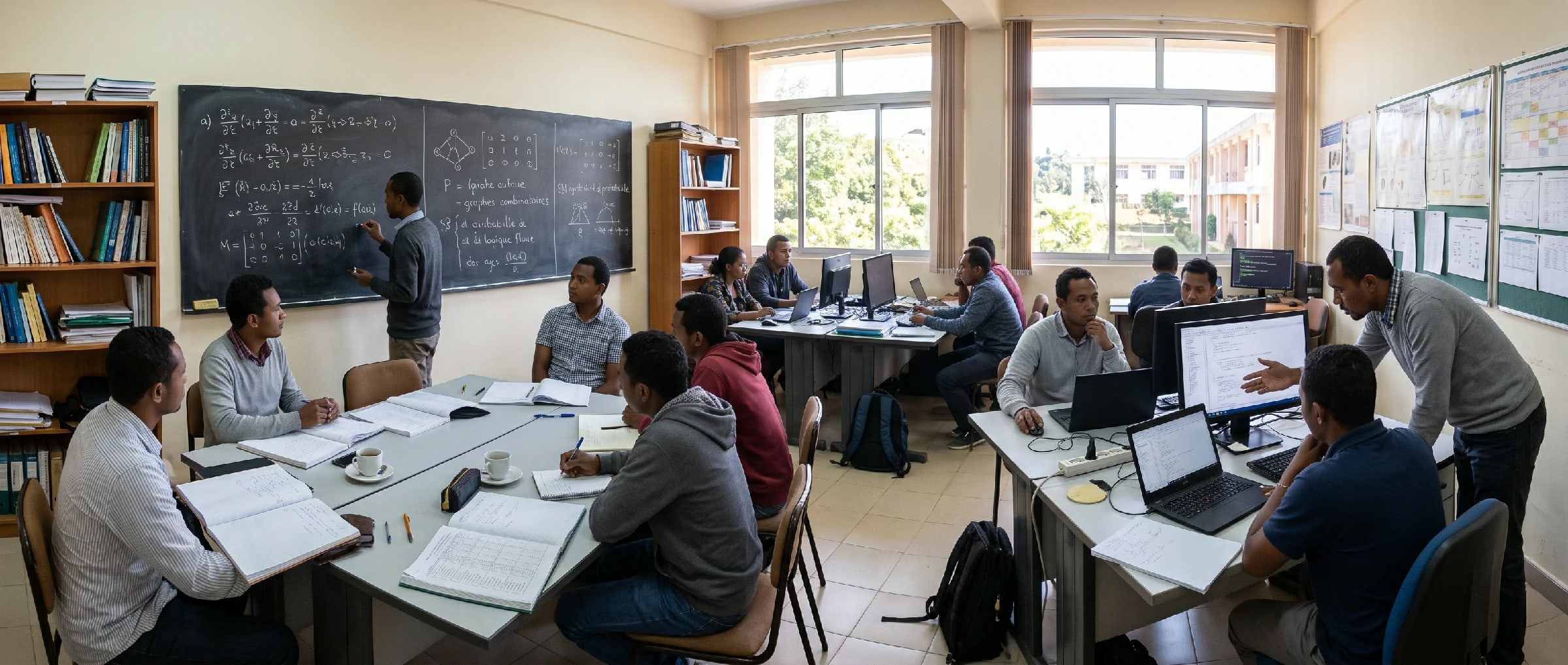
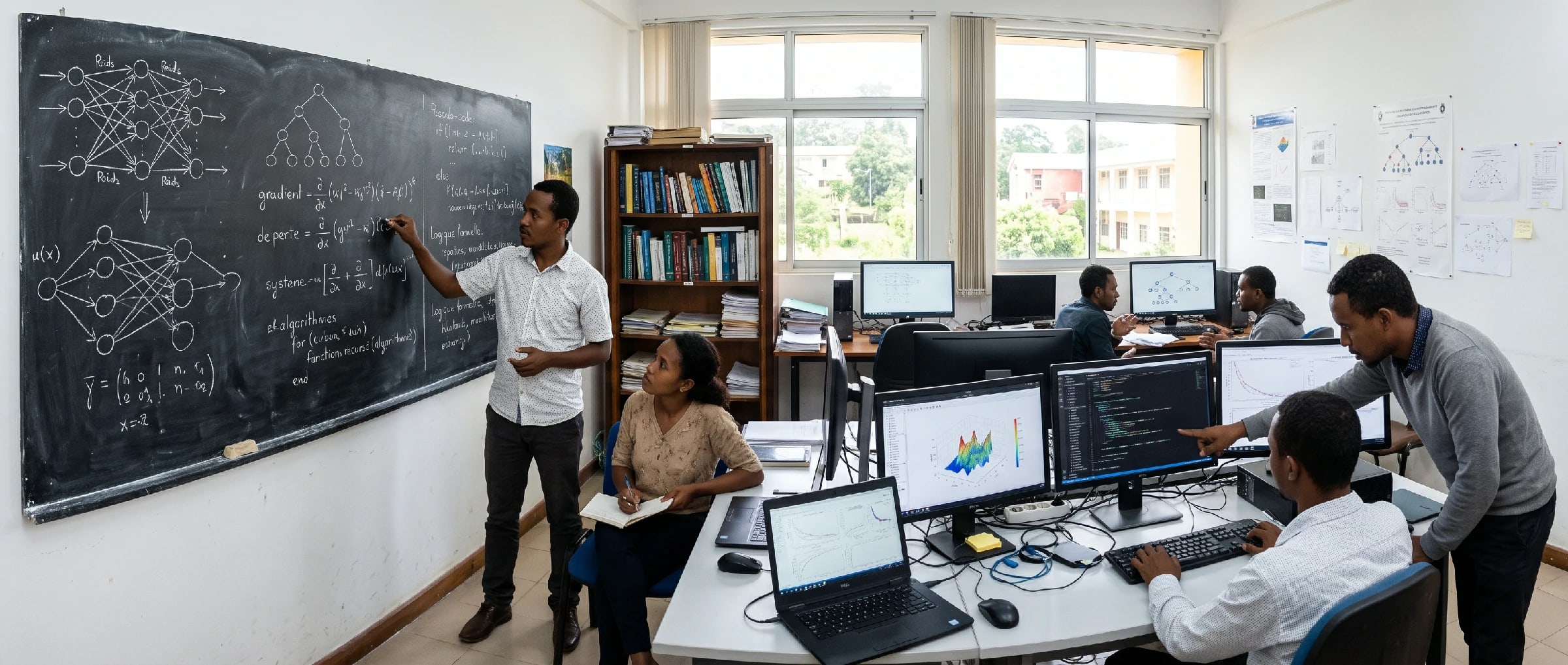
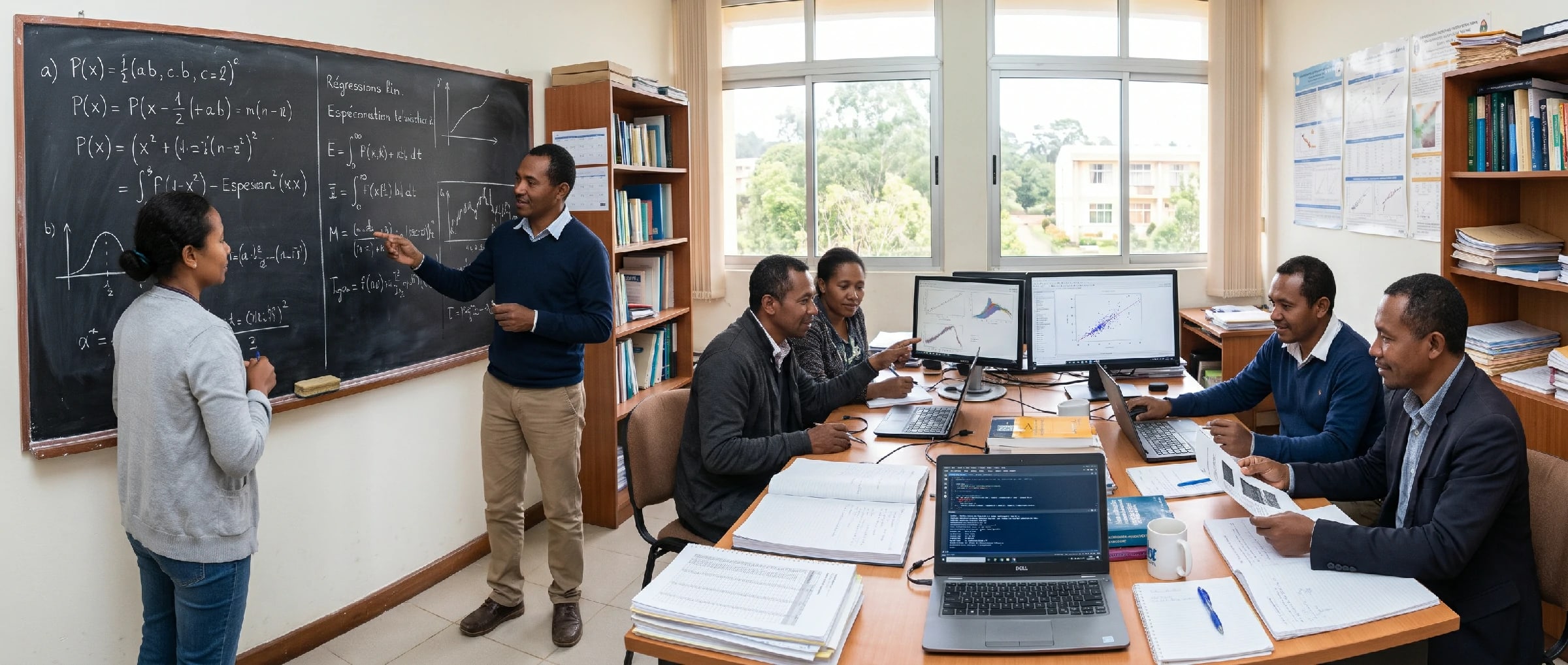









Laboratory of Mathematics and Applications of the University of Fianarantsoa - Image 1
Laboratory of Mathematics and Applications of the University of Fianarantsoa - Image 2
Laboratory of Mathematics and Applications of the University of Fianarantsoa - Image 3
Laboratory of Mathematics and Applications of the University of Fianarantsoa - Image 4
Back to laboratories

Laboratory of Mathematics and Applications of the University of Fianarantsoa

(LAMAF)
29 publications found
7 Affiliated Researchers
Research Structure & Divisions

Research Axes & Teams

LaMAF research is structured around 4 major divisions, combining theoretical rigor, scientific computing, and artificial intelligence.

Scientific Divisions4 Divisions
Researchers & Members13 Members
σμ∫
PSE5 affiliated members

Probability, Statistics & Econometrics

Stochastic modeling, statistical inference, time series analysis, applied econometrics, and random processes.

ℤ/pℤ⊕∏
CATN3 affiliated members

Combinatorics, Algebra & Number Theory

Algebraic structures, enumerative combinatorics, advanced arithmetic, cryptography, and discrete geometry.

Axis Researchers & Team3 members
01101100AI
IMIA2 affiliated members

Mathematical Computer Science & Artificial Intelligence

Advanced algorithmics, graph theory, machine learning, continuous and discrete optimization, and scientific computing.

∇²u∂u/∂tμ(x)
EDPLFD3 affiliated members

Partial Differential Equations, Fuzzy Logic & Decision

Functional and numerical analysis of PDEs, continuous media modeling, fuzzy systems, and multicriteria decision analysis.

Institutional Overview

The Laboratoire de Mathématiques et Applications de l’Université de Fianarantsoa (LaMAF), or Laboratory of Mathematics and Applications of the University of Fianarantsoa, is a research unit within the Faculty of Sciences of the University of Fianarantsoa. It brings together academic researchers, doctoral students and pre-doctoral students around research in mathematics and its fields of application.

Its work is organized into four research areas:

  • Probability, Statistics and Econometrics (PSE): modeling of random phenomena, statistical analysis and processing of data, and econometric models.
  • Combinatorics, Algebra and Number Theory (CATN): study of discrete structures, algebraic structures and the properties of numbers.
  • Mathematical Computer Science and Artificial Intelligence (IMIA): mathematical foundations of computer science and artificial intelligence methods.
  • Partial Differential Equations, Fuzzy Logic, Decision (EDPLFD): analysis and modeling through partial differential equations, fuzzy logic and decision support.

Each area is led by a head, and the laboratory has sixteen members in total. It combines established researchers and early-career researchers in doctoral training, which supports mentoring and the development of the next generation of scientists within the Faculty of Sciences.

LaMAF Scientific Publications

29 publications found
Page 1 of 4

Encompassing Test for Non-nested Linear and Nearest Neighbor Regressions Under Mixing Conditions

Authors: Patrick Rakotomarolahy
Abstract

Encompassing tests compare two non-nested competing models to determine whether one model contains all the relevant information captured by the other. They were developed based on the assumption of independence, particularly in cases involving parametric and non-parametric regression methods. However, this assumption is too restrictive since econometric dynamic models and time series rarely exhibit perfect independence. One challenge would be extending results for i.i.d. variables to dependent processes. We are interested in the φ-mixing dependence measure because of its properties, such as the fast decay rate. Consequently, the Central Limit Theorem (CLT) was previously obtained under significantly weaker mild conditions than those required for other mixing notions. This leads to better asymptotic behavior propreties for test statistics, despite practical constraints of the φ-mixing condition compared to weaker dependence measures. We examine the encompassing test for linear parametric and nonparametric nearest neighbor regression methods for φ-mixing processes. We establish the asymptotic normality of the encompassing statistics associated with the encompassing hypotheses. Our results are comparable to those obtained using popular methods in the literature, such as kernel regression. We achieve convergence rates of order k−1/2 for the tests related to the nonparametric as rival model, and n−1/2 for the parametric as rival model. These rates are the same as in the i.i.d. case. The asymptotic variances of the tests are well-defined due to the fast decay of the φ-mixing coefficients. Unlike many tests with nonparametric regression methods, ours do not depend on any density.

Second Order Properties of Nearest Neighbor Regression with Uniform Weighting Function for Strongly Mixing Processes

Authors: Patrick Rakotomarolahy
Abstract

We examine the statistical properties of nearest neighbor regression function estimation beyond the classical i.i.d assumption. Second-order properties of this estimator for uniformly mixing processes have been derived in previous studies. Nevertheless, uniform mixing is a very strong form of dependence that is difficult to achieve. In contrast, strong mixing conditions are satisfied by a broad class of stochastic processes commonly encountered in theoretical and applied time series modeling. This paper focuses on the analysis of the second-order properties of the nearest neighbor regression estimator under strong mixing dependence measure. Under appropriate regularity conditions, including strong mixing assumptions and smoothness of the underlying density functions, we derive expressions for both the bias and the quadratic mean squared error (QMSE) of the nearest neighbor regression estimator with a uniform weighting scheme for estimating the unknown conditional mean function. Our results demonstrate that the QMSE of the nearest neighbor estimator attains the minimax-optimal rate for estimating a p-smooth regression function in a d-dimensional embedding space. The theoretical analysis integrates the dependence structure specific to strongly mixing processes with the geometric characteristics of k-nearest neighborhoods. This combination enables the identification of an optimal choice for the number of nearest neighbors that effectively balances the trade-off between bias and variance. Overall, these findings provide a rigorous theoretical foundation for the application of nearest neighbor regression methods to short-range dependent data. Furthermore, the explicit bias and variance characterizations lay the groundwork for establishing asymptotic normality, thereby enabling the construction of valid confidence intervals and supporting reliable statistical inference in dependent data settings.

Explicit formulas and combinatorial interpretation of triangular arrays via weighted paths

Authors: Aubert Voalaza Mahavily Romuald, Randrianirina Benjamin
Abstract

**Abstract:** Using the lattice paths in $\mathbb{N} \times \mathbb{N}$, we derive a general formula for sequences $T(n, k)$ satisfying the recurrence relation of the form: $$T(n, k) = a_{n,k}T(n - 1, k) + b_{n,k}T(n - 1, k - 1)$$ We apply this result to the case where $a_{n,k} = a_0 + a_1k + a_2n$ and $b_{n,k} = b_0 + b_1k + b_2n$. This leads to explicit expressions for $T(n, k)$, with simpler formulas arising in the case $b_2 = 0$, as well as in the fully general case, using Faà di Bruno’s type expression. In particular, we analyze the case $b_{n,k} = 1$, which frequently occurs in enumerative combinatorics. Applications include explicit formulas for the $r$-Eulerian numbers. We also express the case $b_{n,k} = 1$ using a transition matrix. We apply our results to several sequences. **Keywords:** Combinatorial interpretation; Triangular recurrence; $r$-Eulerian numbers; Weighted paths **2020 Mathematics Subject Classification:** 05A05; 05A15; 05A19

Species, Symmetric Functions, and Kronecker Product

Authors: Josaphat Baolahy, Randrianirina Benjamin
Abstract

We study two new families of symmetric functions arising from a species-theoretic construction motivated by cycle structure. For each partition of $n$, we define two combinatorial species that decompose into molecules indexed by the same partition, giving rise to two corresponding basis of the homogeneous symmetric functions of degree $n$. We prove that each of these families forms a basis by exhibiting explicit cycle-index formulas and triangular transition matrices to the power-sum basis. Using these constructions, we generalize a classical result describing the Kronecker (Hadamard) product in the homogeneous basis to the two new settings. In particular, we show that the categories generated by these species are closed under the Kronecker product, and that the product of two basis elements expands with nonnegative integer coefficients. Our results provide a new combinatorial framework for studying the Kronecker product and suggest avenues toward interpreting its structure constants

Ensemble Learning and an Adaptive Neuro-Fuzzy Inference System for Cryptocurrency Volatility Forecasting

Authors: Saralees Nadarajah, Jules Clement Mba, Patrick Rakotomarolahy, Henri T. J. E. Ratolojanahary
Abstract

The purpose of this study is to conduct an empirical comparative study of volatility models for three of the most popular cryptocurrencies. We study the volatility of the following cryptocurrencies: Bitcoin, Ethereum, and Litecoin. We consider the GARCH-type, boosting-family-tree-based ensemble learning, and ANFIS volatility models for these financial crypto-assets, which some have claimed capture stylized facts about cryptocurrency volatility well. We conduct comparative studies on in-sample and out-of-sample empirical analyses. The results show that tree-based ensemble learning delivers better forecast accuracy. Nevertheless, the performance of some GARCH-type volatility models is relatively close to that of the best model on both training and evaluation samples.

Empirical Calibration of XGBoost Model Hyperparameters Using the Bayesian Optimisation Method: The Case of Bitcoin Volatility

Authors: Saralees Nadarajah, Jules Clement Mba, Ndaohialy Manda Vy Ravonimanantsoa, Patrick Rakotomarolahy, Henri T. J. E. Ratolojanahary
Abstract

Ensemble learning techniques continue to show greater interest in forecasting the volatility of cryptocurrency assets. In particular, XGBoost, an ensemble learning technique, has been shown in recent studies to provide the most accurate forecast of Bitcoin volatility. However, the performance of XGBoost largely depends on the tuning of its hyperparameters. In this study, we examine the effectiveness of the Bayesian optimization method for tuning the XGBoost hyperparameters for Bitcoin volatility forecasting. We chose to explore this method rather than the most commonly used manual, grid, and random hyperparameter choices due to its ability to predict the most promising areas of hyperparameter spaces through exploitation and exploration using acquisition functions, as well as its ability to minimize error with a reduced amount of time and resources required to find an optimal configuration. The obtained XGBoost configuration improves the forecast accuracy of Bitcoin volatility. Our empirical results, based on letting the data speak for itself, could be used for a comparative study on Bitcoin volatility forecasting. This would also be important for volatility trading, option pricing, and managing portfolios related to Bitcoin.

2025Revue Française d’Économie et de Gestion, volume 6, numéro 10PDF Drive
Researcher :Rivo RAKOTOZAFYMCF
LAMAF • Laboratoire de Mathématiques et Applications de l'Université de Fianarantsoa

Contrat progressif en microfinance solidaire : une modélisation markovienne du revenu actualisé avec exclusion réversible

Authors: Philibert Andriamanantena, Issouf Abdou, Francine Diener, Mamy Raoul Ravelomanana et Nahla Dhib, Rivo Rakotozafy
Abstract

Cet article propose une modélisation probabiliste du prêt solidaire en microfinance à l’aide d’une chaîne de Markov à temps discret. Le contrat étudié repose sur une dynamique progressive intégrant une phase probatoire, une inclusion durable et une exclusion réversible. À partir d’une fonction de flux de revenu associée aux transitions, nous définissons un revenu actualisé moyen permettant d’évaluer la viabilité économique de l’institution. L’existence d’un régime stationnaire est démontrée et exploitée pour formuler un problème d’optimisation dynamique des paramètres contractuels. Des simulations numériques et une généralisation multi-agents permettent enfin de comparer l’efficacité du prêt solidaire à celle du prêt individuel. Ce cadre analytique offre des outils d’aide à la décision pour concevoir des contrats conciliant viabilité financière et inclusion sociale.

2025Revue Française d’Économie et de Gestion, volume 6, numéro 10PDF Drive
Researcher :Rivo RAKOTOZAFYMCF
LAMAF • Laboratoire de Mathématiques et Applications de l'Université de Fianarantsoa

Contrats de microcrédit à double sanction sociale : une approche markovienne de la viabilité incitative

Authors: Philibert ANDRIAMANANTENA, Issouf ABDOU, Mamy Raoul RAVELOMANANA, Rivo RAKOTOZAFY
Abstract

Cet article propose une modélisation markovienne du contrat de microcrédit à double sanction sociale, combinant une sanction institutionnelle (exclusion graduelle) et une sanction communautaire (pression sociale et réputation). L’analyse stationnaire permet d’identifier les conditions de viabilité et de mettre en évidence l’effet disciplinaire de la double sanction sur les comportements opportunistes. Afin d’accroître la pertinence empirique, le modèle est étendu à une distribution continue de risques (loi bêta), à une réputation dynamique et à une règle optimale de calibrage des sanctions. Sur le plan opérationnel, trois scénarios de mise en œuvre sont proposés : probation, fidélisation avec sanction croisée, et réintégration conditionnée à la réputation. Ces résultats contribuent à la littérature sur les contrats incitatifs en microfinance en conciliant rigueur analytique et applicabilité pratique.