
Laboratoire de Physique Appliquée de l'Université de Fianarantsoa - Image 1
Laboratoire de Physique Appliquée de l'Université de Fianarantsoa - Image 2
Retour aux laboratoires

Laboratoire de Physique Appliquée de l'Université de Fianarantsoa

(LAPAUF)
Recherche
45 publications trouvées
7 Chercheurs rattachés

Présentation

Création : ouvert en 2005-2006, Arrêté N° 06/054/UF/PR du 12 juillet 2006. Rattachement : Mention Physique et Applications.

Le LAPAUF est le laboratoire de recherche en physique de la Faculté. Il prolonge la formation de troisième cycle en Physique appliquée (DEA), ouverte en 2001 (Arrêté ministériel N° 4020/2001 du 3 avril 2001), et accueille aujourd'hui la recherche adossée au Master Recherche de la mention Physique et Applications.

Domaines d'activité

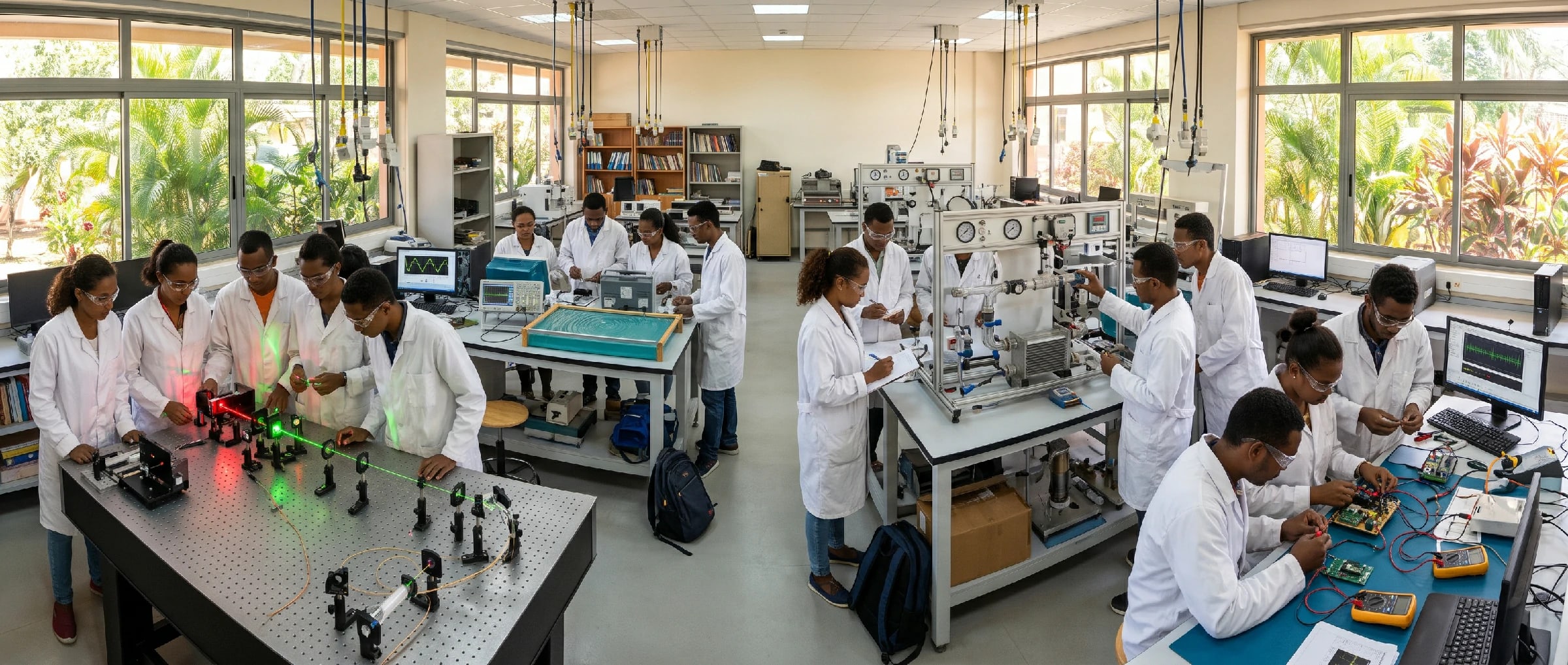
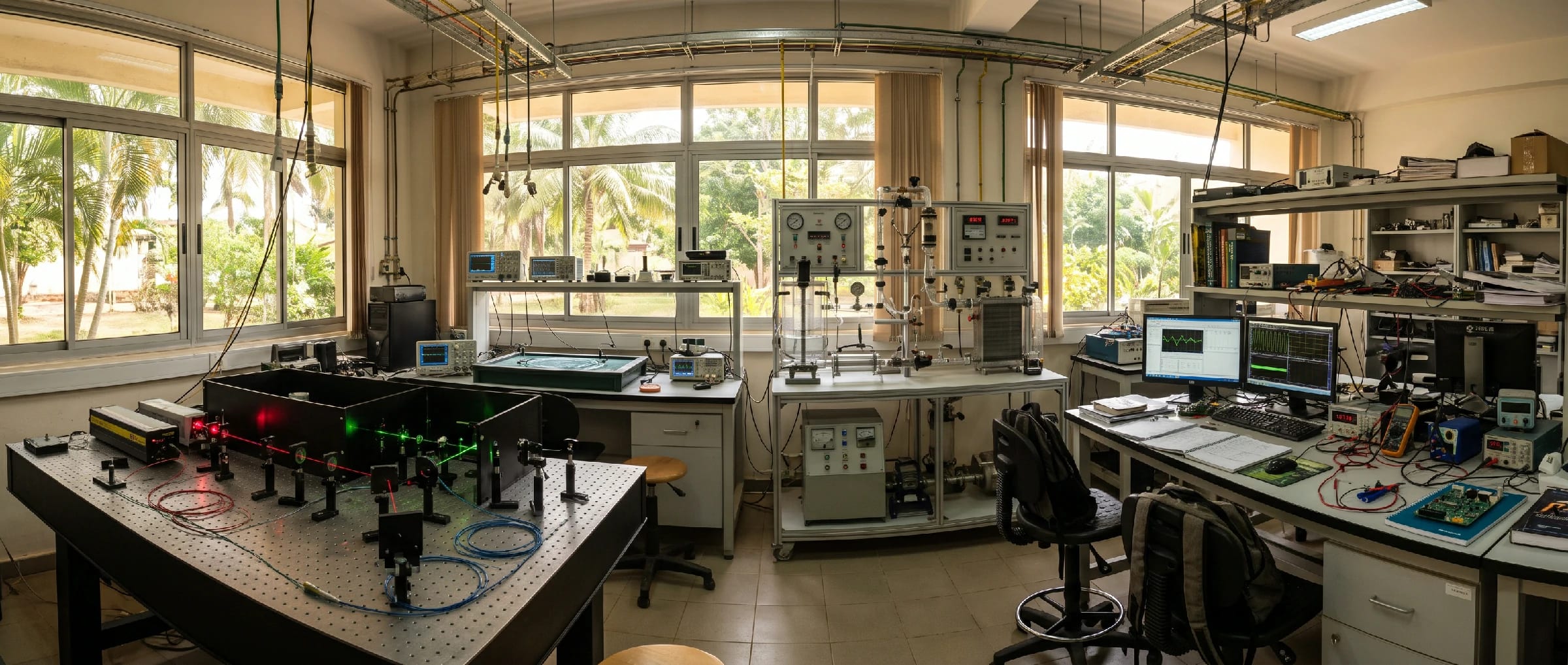
  • Composants acoustiques et photoniques : capteurs optiques et acoustiques, traitement du signal et imagerie, systèmes de détection.
  • Mécanique, énergétique et transferts : transferts thermiques et massiques, mécanique des fluides, efficacité énergétique, énergies renouvelables, modélisation et simulation des systèmes thermo-fluides.
  • Électronique appliquée et informatique industrielle, en appui à la Licence EA2I.

Missions

  • Encadrer les travaux de recherche des étudiants de Master et préparer à la poursuite en doctorat (physique, mécanique, énergétique, thermique, mécanique des fluides, énergies renouvelables).
  • Soutenir les travaux pratiques et l'expérimentation des parcours de physique.
  • Répondre aux enjeux énergétiques de Madagascar (combustibles, électricité, confort thermique), en lien avec le parcours Énergie renouvelable.

Publications Récentes

45 publications trouvées
Page 1 sur 6

Spectral element method for optical planar waveguide modal analysis

Auteurs: Gérard Granet, Malalatiana Rinah Rasoamilanto, Karyl Raniriharinosy, Kofi Edee, Manjakavola Honoré Randriamihaja
2 enseignants co-auteurs
Résumé de la publication

A spectral element method is developed for determining the propagation constants of guided and leaky modes in planar multilayer waveguides. The originality of the technique lies in what we believe to be a novel combination of a hierarchical basis built with modified Legendre polynomials and a rational mapping that efficiently handles semi-infinite computational subdomains. To handle leaky waves, we extend the algebraic mapping to complex coordinates that act as perfectly matched layers (PMLs). The method thus naturally enforces both radiation conditions at infinity and boundary conditions at material interfaces, leading to improved convergence properties without additional constraints or numerical treatments. The efficiency and numerical precision of our method are demonstrated through comparisons with results from the literature for high-index-contrast dielectric and plasmonic waveguides, ARROW anisotropic structures, and quantum well waveguides.


Vertical Modes on Snake Gratings

Auteurs: Malalatiana Rinah Rasoamilanto, Manjakavola Honoré Randriamihaja, Gérard Granet, Karyl Raniriharinosy
2 enseignants co-auteurs
Résumé de la publication

In a waveguide, vertical (or transverse) modes are specific configurations of the electric and magnetic fields whose properties can be finely tuned using periodic structures. In this study, we investigate the excitation and propagation of vertical modes on a sinusoidal grating, periodically repeated along another spatial direction, referred to as a snake grating. This type of structure enables a significant enhancement of the coupling between incident light waves and vertical modes. Using the method of moments, in which a tensor product of a Fourier basis and Legendre polynomials serves as the expansion and projection functions, we demonstrate a strong sensitivity of vertical modes to the geometric parameters of the grating. The expected result is the excitation of vertical modes for both transverse magnetic (TM) and transverse electric (TE) polarizations on the snake grating, thus allowing more flexible light manipulation and the development of more efficient optical devices.

MODELING AND SIMULATION OF DATA FOR THE IDENTIFICATION AND PREDICTION OF THE BEHAVIOR OF LAKE ALAOTRA IN MAGASCAR

Auteurs: RABOTOVAO David Sebas, ANDRIAZAFIMAHAZO Lahinirina Fridolin, RATSIMBAZAFY Aro Pascal, ROBIJAONA RAHELIVOLOLONIAINA Baholy, RAJAONAH Rabevala
Résumé de la publication

The sustainable management of the Lake Alaotra-Mangoro system, a vital ecological and socio-economic resource in eastern Madagascar, is severely threatenedby rapid anthropogenic pressures and climate change. This study aimed to characterize the complex lacustrine and fluvial dynamics and predict the system'sbehavior to support informed conservation and planning efforts. We employed a rigorous two-dimensional (2D) hydrodynamic modeling approach usingtheInternational River Interface Cooperative (IRIC) software. The model integrated comprehensive topographical, hydrological, and meteorological data to simulateflow behavior over a transient event. The analysis revealed critical insights into the system's vulnerability. Simulation outputs accurately defined areas susceptibleto localized flooding and quantified seasonal water level variations. Hydrodynamic analysis confirmed complex flow interactions, including the concentrationof maximum velocity and depth within the channel's thalweg and the presence of a downstream backwater effect indicated by an inverse water surface elevationgradient. Furthermore, cross-sectional profiles validated the model's ability to capture asymmetrical channel geometry, which is crucial for bank erosionriskassessment. Supporting land-use analysis highlighted significant land degradation and marshland loss, exacerbating the hydrological response. In conclusion, theIRIC model provides robust predictive capability for evaluating the cumulative impacts of environmental change. A primary recommendation is the urgent needto strengthen the local hydrometeorological monitoring network to enhance data quality and model reliability. The findings facilitate the proactive planningof adaptive strategies, including the construction of protective dikes, targeted reforestation, and essential agricultural adjustments, ensuring the long-termresilienceof the Lake Alaotra watershed. Keywords: Lake Alaotra, Hydrodynamic Modeling, IRIC, Flood Risk, Land Use Change.

2-D Modeling and Experimental Study of a Transverse-Mode Piezoelectric Transformer with Common Ground Electrodes Using a Lead-Free Ceramic

Auteurs: Joli Randrianarivelo, Mohamed Rguiti, Faniry Emilson Ratolojanahary, Dame Fall, Marc Duquennoy, Lahoucine Elmaimouni, Mohamed Aymen Ben Achour
Résumé de la publication

Building upon our previous work, this paper presents a two-dimensional (2D) modeling of a transverse-type rectangular piezoelectric transformer with common ground electrodes based on the Legendre Polynomial Approach (LPA), under the plane stress assumption and without neglecting the length between the primary and secondary electrodes called gap. Aiming to confirm the validated previous theoretical predictions obtained via PZT-5A ceramic, the studied device was designed, realized, and characterized from lead-free ceramic by selecting Barium Titanate (BaTiO or BT, belonging to the 4mm crystallographic point group of the tetragonal system) film in compliance with the European directive on lead (Pb) usage. Problem resolution via LPA lies in the formulation of mechanical displacement and electric potential, expanded in each region as a series of orthonormal Legendre polynomials with appropriate expressions, specifically constructed to satisfy boundary and continuity conditions, which are directly incorporated into the propagation equations through the delta function. Then, analytical results are modeled numerically using Matlab software. In addition, a three-dimensional (3D) numerical simulation of the same structure was performed by applying the Finite Element Model (FEM) using Comsol Multiphysics software. Electrical and mechanical responses were obtained. Results found from both FEM and LPA strongly match the experimental data. Finally, the proposed method enabled the detailed study, analysis, and optimization of all physical quantities and parameters within this electromechanical device, for improving its performance.

2024Iranian Journal of Science and Technology, Transactions of Mechanical EngineeringLAPAUF • Applied Physics Laboratory of the University of Fianarantsoa

Wave Propagation Characteristics in A MEMS Piezoelectric Annular Plate: A Semi-analytical Study

Auteurs: Hassna Khalfi, Ismail Naciri, Rabab Raghib, Lahoucine Elmaimouni, Faniry Emilson Ratolojanahary, Abdellah Benami, Jiangong Yu
Résumé de la publication

Our paper focuses on wave propagation in a circular annular piezoelectric plate with hexagonal elastic symmetry used in Micro-Electromechanical Systems (MEMS). The objective is to examine the properties of two piezoelectric materials: PZT-5A, a soft ceramic used in ultrasonic sensors, and PZT-4, a strong ceramic used in ultrasonic actuators. We developed the Legendre orthogonal polynomial method to obtain semi-analytical solutions for the governing equations. One strength of our method is that it can analyze the global structure using a single formalism calculation. The analysis takes into consideration the alternating current excitation and directly includes the boundary conditions into the vibration equations. As a result, we found that the limit value of voltage across the electrodes equals that can be applied to determine the maximum von Mises stress without exceeding the yield stress value of for the PZT4. The electromechanical coupling coefficient shows that the fundamental mode is the most piezoactive mode in the structure. Furthermore, we present the natural frequencies, electrical input impedance, field profiles, and dispersion curves. To validate the efficiency and accuracy of our approach, we compared our results with those obtained using voltage excitation and analytical data. Ultimately, we achieved a good agreement between them.

Modal analysis of diffraction by snake gratings using a tensor product of pseudo-periodic functions and Legendre polynomials

Auteurs: Malalatiana Rinah Rasoamilanto, Manjakavola Honoré Randriamihaja, Lala Bakonirina Andriamanampisoa, Gérard Granet, Karyl Raniriharinosy
3 enseignants co-auteurs
Résumé de la publication

The problem of diffraction by snake gratings is presented and formulated as an eigenvalue eigenvector problem. A numerical solution is obtained thanks to the method of moments where a tensor product of pseudo-periodic functions and Legendre polynomials is used as expansion and test functions. The method is validated by comparison with the usual Fourier modal method (FMM) as applied to crossed gratings. Our method is shown to be more efficient than the FMM in the case of metallic gratings.

Scattering by cylinders with an arbitrary cross-section using domain decomposition and polynomial expansions

Auteurs: T. A. Rafalimanana, G. Granet, K. D. Raniriharinosy
Résumé de la publication

In this paper, the electromagnetic field scattered by a cylinder with an arbitrary cross section is computed using a domain decomposition method in which the structure under consideration is enclosed with two fictitious circular cylinders. TE and TM polarizations are investigated. Our code is successfully validated by comparison with analytical results and with the finite element software COMSOL.

Using multilayered neural networks for determining global solar radiation upon tilted surface in Fianarantsoa Madagascar

Auteurs: Ignace Abel José Razafiarison, Lahinirina Fridolin Gervais Andriazafimahazo, Bertin Olivier Andriantiana Ramamonjisoa, Belkacem Zeghmati
Résumé de la publication

The knowledge of the local solar radiation characteristics is indispensable in the survey of any system exploiting solar energy in any location. The author is particularly interested by the global solar radiance upon tilted surface per time unit to help operators using solar energy in their work. The target is, among others, helping solar drying operators that need while tuning drying system the knowledge of the global solar radiation that could be received on inclined solar captors in implantation site. The aim of this paper is to use neural network method to search for solar radiation upon a tilted surface. Multilayered neural networks (MNN) trained by gradient back-propagation are used to determine numeric values of monthly means and hourly variations of the global solar radiation upon a titled surface per time unit. The numerical calculations are made with the geographical and meteorological parameters (latitude, longitude and clearness index) of the location of Fianarantsoa, Madagascar.

Laboratoire de Physique Appliquée de l'Université de Fianarantsoa (LAPAUF) | Faculté des Sciences